From Linear to Logistic Regression in Apparel Retail
In the data-driven world of apparel retail — especially in saree and ethnic wear — predictive models are increasingly used to forecast outcomes and guide business decisions. While linear regression is well known for predicting continuous variables like sales quantity or revenue, the real challenge often lies in predicting whether an event will occur — such as whether a customer will buy a saree or not.
This is where logistic regression comes in. It provides a robust framework to model probabilities of binary outcomes, transforming how we make product recommendations, optimize assortment, and understand customer behavior.
Linear Regression: Predicting a Value
In traditional regression settings, we use a linear equation to predict a numeric outcome:
Where:
- y is the predicted sales (units or revenue)
- x is the vector of product or customer features (e.g., price, fabric quality, brand)
- w are learned weights
- b is the bias term
This works well when we're estimating sales amounts or forecasting inventory. But it doesn't answer questions like:
That’s a yes-or-no decision — a binary outcome. For this, we need a model that gives us a probability.
Logistic Regression: Modeling Probability
Instead of predicting y directly, logistic regression predicts the log-odds of the outcome:
This quantity is called the logit — the natural logarithm of the odds of the event occurring. Since the right-hand side is a linear expression, it can safely take on any real number.
To convert the log-odds back to a probability, we apply the sigmoid function:
Interpretation
- If wTx + b is large and positive, then p approaches 1 → customer likely buys - If it is large and negative, p approaches 0 → customer likely does not buy - If it is around 0, then p ≈ 0.5 → uncertainty
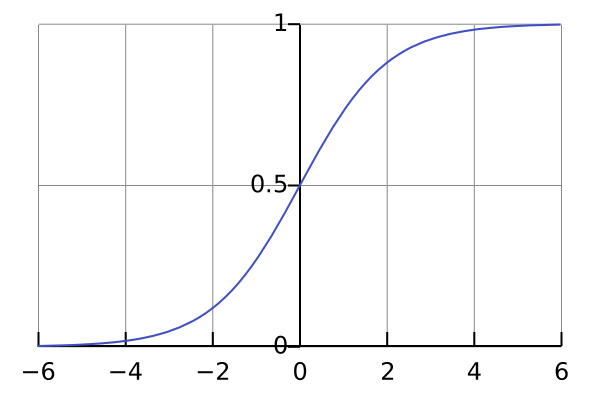
Figure 1: Sigmoid function transforms logits to probability space
Retail Use Case: Saree Purchase Prediction
Suppose we’re building a model to estimate whether a customer will buy a saree based on:
- Fabric quality (0 to 1)
- Styling appeal (0 to 1)
- Price (in ₹1000s)
We define a logit model:
For a given saree with fabric = 0.9, style = 0.8, and price = ₹12,000, we compute:
z = 3.2(0.9) + 2.0(0.8) - 0.8(12) + 1.0 = 2.88 + 1.6 - 9.6 + 1.0 = -4.12
Then apply the sigmoid:
So there's only about a 1.6% chance this saree will be bought — likely overpriced or misaligned with customer preference.
---Why Log-Odds? Why Not Just Model Probability Directly?
Because probabilities are bounded (0 to 1), and linear models are not. So if we model probability directly:
It may yield invalid outputs like p = 1.3 or p = -0.2. That's not acceptable. By working in log-odds space (unbounded), we ensure:
- Mathematical safety
- Interpretability: additive weights in log-odds mean multiplicative odds in probability
From Prediction to Decision
Once we have the probabilities, we can:
- Rank sarees by likelihood of purchase
- Trigger targeted offers (e.g., if p > 0.8)
- Optimize product displays and assortments

Figure 2: Logistic regression models probabilities for classification
Conclusion
In apparel retail, particularly in the personalized and visual world of sarees, it’s not always about “how much” a customer will buy. It’s often about “whether” they will buy at all.
By switching from linear to logistic regression, we align our modeling approach with the binary nature of customer decisions and unlock powerful applications in recommendation, assortment planning, and sales forecasting.
As retail becomes more intelligent and data-driven, understanding the difference between predicting a number and predicting a behavior may just be the edge your business needs.
— Written for research and analytics professionals in fashion retail

No comments:
Post a Comment